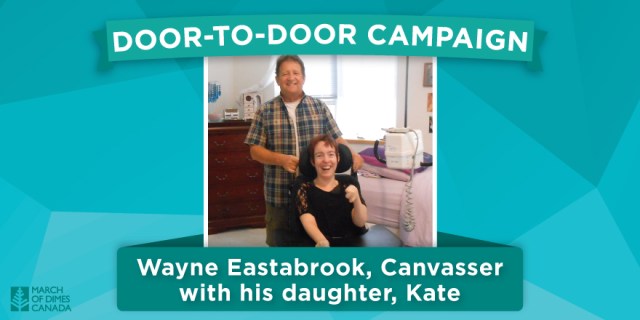
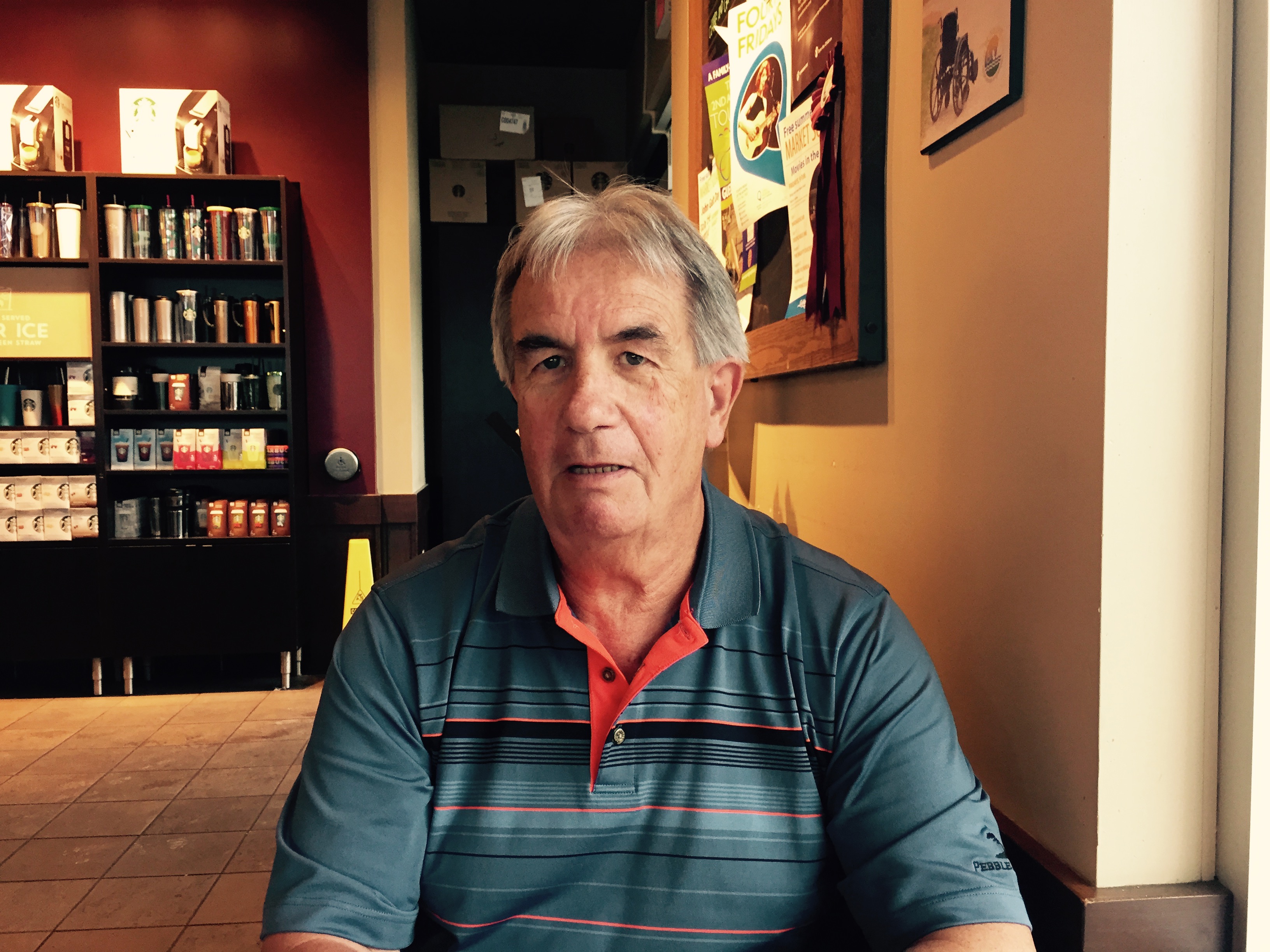
Peterborough resident Wayne Eastabrook has been canvassing his neighbourhood in support of March of Dimes Canada’s Door-to-Door Campaign for over a decade. He was first driven to support the Campaign after the organization provided financial assistance to his daughter Kate that allowed her to move into her own apartment.
“I don’t believe that Kate would be able to be as independent and live on her own without the support of March of Dimes Canada,” says Wayne. “It made the transition from our home into a supported apartment so much easier, and our whole family is very grateful for this.”
He started canvassing his neighbours and is able to raise $300 -$400 each year. His community members know he’s coming, and are prepared with a small donation when Wayne comes to their door.
“I like to canvass in January, because how can anybody turn away a man in the cold,” jokes Wayne. “But really, I like to remind my neighbours that this a good cause, helping people in their community, and that every bit counts” he says.
Wayne believes in paying it forward, in addition to supporting March of Dimes Canada, he is also the Board President of Community Living Peterborough.
“I know that there are needs in the community, and somehow, we have to help,” says Wayne.
Want to be part of our Door-to-door campaign but are unable to physically go door-to-door? This is an easy fix! You can now sign up as an online canvasser – here’s the link: http://bit.ly/D2DOnline Help us support Canadians living with disabilities!
On Tuesday, September 29th, one of our L.I.F.E. Mississauga Instructors, Jamie Hutchins was able to attend the Federal Election Forum on Accessibility and Disability. Below are his thoughts on how the forum went:
“Yesterday, there was a forum concerning issues of accessibility and disability. Federal election candidates from various Toronto ridings were present to discuss their party’s platform regarding disability and accessibility.
Mike Sullivan represented the NDP, Arnold Chan. the Liberal Party and Sharon Danley, the Green Party. The conservative party was contacted, but no member volunteered to come and speak to those issues.
A snapshot of the crowd at the forum on Accessibility and Disability
As for the discussion itself, there were several key points that I found intriguing. Primarily, all parties insisted that the largest adversary to the disability/accessibility movement is the Conservative government. Each federal representative said that the largest obstacle to adhering to the UN Convention on Rights of Persons with Disabilities has been the Conservative government.
All parties, except the Conservatives, have vowed to fulfill its international (and ethical) commitments. Furthermore, the NDP and Green party explicitly stated that they intend to create a national policy on accessibility and disability (Canadian Disabilities Act). Although Arnold Chan also expressed a desire to legislate such an act, he was not able to comment whether it was on the executive’s (Trudeau and his potential cabinet) agenda.
Secondly, I was astounded at the depth of the questions. To be clear, this discussion was specifically designed to appeal to persons with disabilities. Some of the questions designed covered topics including a Canadian Disabilities Act (CDA), physician-assisted suicide, a national housing strategy, disability representation in the HoC, adherence to the UN conventions and an increased pressure on provincial governments to administer better services.
Each speaker outlined his/her party’s policy concerning the aforementioned issues. Many candidates repeated old adages of “equality of service”, “reducing poverty”, “more consultation with community agencies and persons with disabilities”, “more adaptive equipment” and “an attitudinal shift”. However, both Sullivan and Danley offered more substantive policy changes should their parties be elected. Sullivan expressed his party’s commitment to enact the CDA within a year. Furthermore, the NDP is the only party to have a committee set up to constantly critique the party’s direction. The committee’s job is to meet with community agencies, listen to their advisement and consequently “hold the party’s feet to the fire”, if they alienate stakeholder rights. Alternatively, the Green Party has advocated to design a national equipment fund so that people with disabilities can exercise their right to live independently.
Thirdly, I was impressed by the turnout and audience participation. Peoples with disabilities were very well-represented and their questions were very specific to their disability. It was exciting to see such human agency from the group. Such a high attendance of persons with disabilities helped solidified the rights and equality rhetoric that accompanied most of the discussion. There was a wide representation of the disability community including persons who are blind, deaf, using mobility devices, having episodic disabilities, cognitive disabilities, learning disabilities, etc. This stressed upon me the importance to try to remedy the current situation regarding persons with disabilities. As a political party looking to get elected, it not only makes sense to move forward because it is proper (and moral) to have disability rights enshrined in legislation, but also because persons with disabilities represent such a large portion of the vote.
Lastly, Ryerson did an excellent job hosting. The adaptive devices allowed for all members of the crowd to participate. In conjunction with the captioning service provided, there were multiple people using both SLQ and ASL to communicate effectively with the deaf audience members. Student volunteers were constantly in the right place to help those with blindness find their seats. There was also one large aisle that allowed mobility devices to go back and forth. Also, I was impressed with the live tweeting of the discussion as this allowed questions to flurry in from Alberta.”
Despite suffering a stroke in 2003 Bill Blodgett is peddling a path he hopes stroke survivors will follow.
While the road to recovery seems daunting Bill feels there is no reason to give up based on his experience. From his progression the Peterborough resident advises survivors to remain positive. He believes there’s always ways to persevere if you want something bad enough.
“There is always hope – Don’t give up. There is always a way to do something. It takes me a little bit longer but there is nothing that stops me from doing what I want to do,” said Bill.
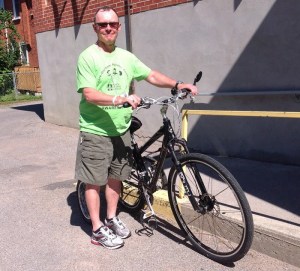
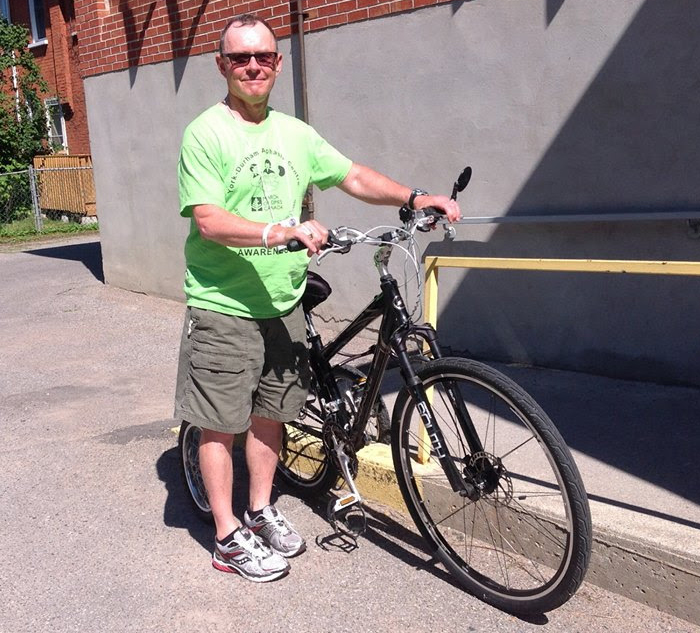
One example of Bill’s perseverance comes from his source of transportation. While Bill’s comfortable with the bus he would not be satisfied without a chance to use his bicycle. With the support of adult stabilizer wheels he’s continued riding his bike for leisure and to attend the two March of Dimes of Canada programs that he volunteers with: the Aphasia and Communication Disabilities Program, and Life After Stroke, a Stroke Recovery Canada chapter in Peterborough.
Bill Blodgett and his love of cycling
Along with his cycling passion Bill began setting his sights on regaining his driver’s license. He’s optimistic after seeing a fellow Life After Stroke volunteer driving a modified car.
For Bill, being a part of his local stroke support chapter has also had a positive impact in his recreational time. Another member of Life After Stroke introduced him to a swimming program at the YMCA. Bill now attends the YMCA three times a week.
Despite always being on a tight schedule Bill recalls never missing the weekly Aphasia program, which he started volunteering for in 2011. He was also named a guest speaker at the York-Durham’s Aphasia’s Centre’s 25th anniversary in 2014.
As a volunteer Bill compliments March of Dimes Canada as an organization full of great ideas and inspirations.
“I would never have dreamt that they would be so innovative.”
Today in Canada there are over 300,000 stroke survivors. Stroke Recovery Canada is helping ease the recovery process and these survivors are surviving and thriving! Over the last few weeks we have been sharing some of these “Turning Points” – the moments when these stroke survivors realised there was hope post-stroke!
Here are the last three Turning Points:
“My turning point was when I realized I was going to survive and with a little work and effort, I was still going to have a life.”
– Shirley Dennis
“My turning point was volunteering at a local peer support program; this allowed me the opportunity to apply some of my recovery tools, and my new normal became dedicated to a life helping others in a similar situation as my own. ”
– David Huson, Guelph Wellington
My Turning Point happened three years post stroke, when I accepted the fact that this is MY NEW NORMAL and that I AM A SURVIVOR, NOT A VICTIM!!
– Paula Povey, New Hamburg
Thanks for reading and please make sure you check out the other entries too!
Today in Canada there are over 300,000 stroke survivors. Stroke Recovery Canada is helping ease the recovery process and these survivors are surviving and thriving! Over the next couple of weeks on Tuesdays and Thursdays we’ll be sharing some of these “Turning Points” – the moments when these stroke survivors realised there was hope post-stroke!
Here are our next three Turning Points:
“I’d say the day I got my license back after not being able to drive for 8 months!”
– Bob Dutru, Niagara
“My turning point was when I learned that I could still ride my bike and swim, albeit not as well as I would like…however practice makes it worth some more.”
– William Blodgett, Peterborough Ontario.
“The day I returned back to volunteering at a school near my home. I feel I am making a difference and it makes me feel proud. I am once again giving back to my community.”
Today in Canada there are over 300,000 stroke survivors. Stroke Recovery Canada is helping ease the recovery process and these survivors are surviving and thriving! Over the next couple of weeks on Tuesdays and Thursdays we’ll be sharing some of these “Turning Points” – the moments when these stroke survivors realised there was hope post-stroke!
Here are our next four Turning Points:
“My turning point was coming to my first peer support meeting and learning that life does go on after a Stroke.”
– Tom Rideout, Toronto
“Our turning point came when Ted and I joined Survivors of Stroke. It was from them that we learned how to deal with the challenges of stroke and that while our lives were irrevocably changed, there was life after stroke.
– Marg Cyr, Niagara
“Every year!! I see subtle changes every year as I try to live my new life to the fullest. I am now celebrating 10 years post stroke, and my new life is full, rich and rewarding.”
– Judy Mostow, Thunder Bay
“After my stroke I could not spell or do Math. Rehabilitation and my family helped me relearn spelling and math. This encouraged me to continue to try more things – playing solitaire, sudoku and getting my driving license back and continuing to write letters. I am now working on crossword puzzles. Small things are “Turning Points” for all of stroke survivors.”
“This is a picture of me and daughters – from left to right Cindy, Valerie, Monica and Margaret – they all helped me after my stroke.”
Today in Canada there are over 300,000 stroke survivors. Stroke Recovery Canada is helping ease the recovery process and these survivors are surviving and thriving! Over the next week we’ll be sharing some of these “Turning Points” – the moments when these stroke survivors realised there was hope post-stroke!
Here are our first three Turning Points:
“After spending 3 days in ICU and looking at an item hanging on the wall, my turning point was to be able tell my girls it was a Fire Extinguisher. My second turning point was when I was able to print all the letters in the alphabet. The first time I tried I could only come up with 16 letters. I could give you dozens more but these two are significant to me. “
– David Ingram, Lindsay
“Shoveling snow this winter for the first time since 2011. Finally being able to help my family with domestic chores”
– Donnie Miller – Stroke Survivor since 2011. SOS Niagara
“The turning point came when I realized that all those travelling on the detour were my true companions and my new tribe. The road is still rough, and hard to travel, from time to time, but knowing there are others helping and understanding makes it a road well-travelled. Wishing you blue skies and a happy heart.”


 Peterborough resident Wayne Eastabrook has been canvassing his neighbourhood in support of March of Dimes Canada’s Door-to-Door Campaign for over a decade. He was first driven to support the Campaign after the organization provided financial assistance to his daughter Kate that allowed her to move into her own apartment.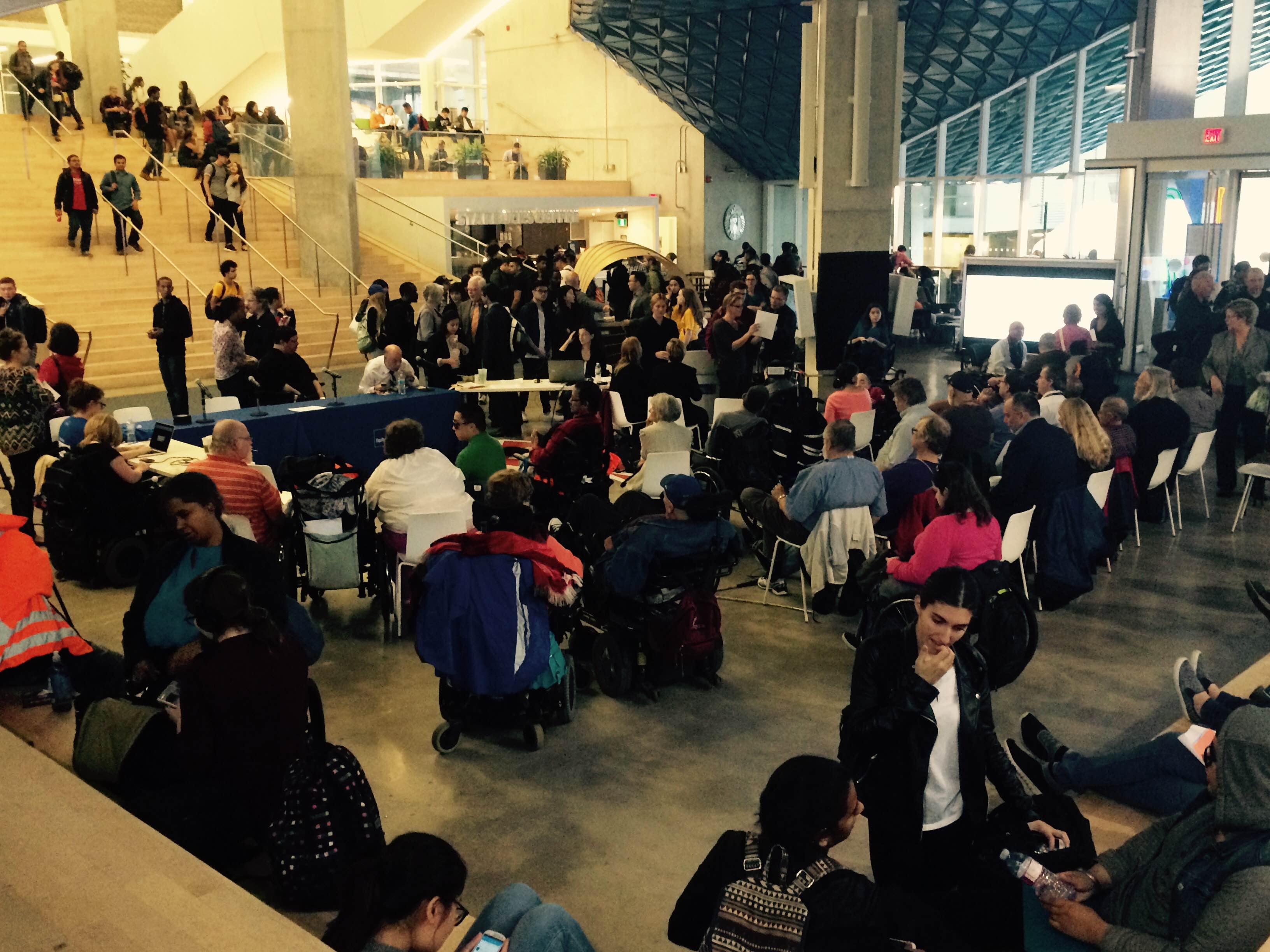








 March of Dimes Canada Community Blog